


Can you sell a house with knob and tube wiring in Wisconsin?
The short answer: you can absolutely sell a house with knob and tube wiring in Wisconsin.
If you own an older Milwaukee home and just found out about knob-and-tube wiring in the walls, you might be wondering whether anyone will actually buy it. No worries, you can sell a house with knob and tube wiring in Wisconsin — but you need to understand the safety basics, follow the state’s disclosure rules, and set realistic expectations about how old wiring affects your buyer pool and pricing.
With years of expertise under my belt in buying houses across Southeastern Wisconsin, I’ve seen hundreds of basements and attics where ceramic knobs and cloth-wrapped wires are still doing their job decades after installation. It’s a common concern with older-home in Milwaukee’s pre-war housing stock.
This guide covers what knob-and-tube wiring actually is, whether it’s dangerous, what Wisconsin law says you have to disclose, what rewiring costs, and how to weigh your options — including selling as-is to a cash buyer — so you can make a confident decision.
What Is Knob and Tube Wiring, and Why It Matters When You Sell
Knob-and-tube wiring is an early residential electrical system — common in homes built from the 1880s through the 1940s — that uses ceramic knobs and tubes to route ungrounded conductors. It lacks the grounding conductor found in modern wiring and is no longer permitted under the National Electrical Code (NEC).
Milwaukee’s pre-war bungalows, duplexes, and Craftsman-style houses across the South Side, East Side, and older inner-ring suburbs are flagged regularly. That’s not unusual and doesn’t make a house unsellable, but as home inspections will note it, lenders and insurers may ask for documentation, and Wisconsin’s Real Estate Condition Report (RECR) specifically lists knob-and-tube as an example of an electrical defect requiring disclosure.
Is Knob and Tube Wiring Safe — and What Worries Buyers and Lenders?
The answer depends more on the condition of the wiring than its age. While knob-and-tube wiring is often viewed as outdated, it is not automatically considered hazardous. The real concern is how the system has aged and whether it has been modified over the years.
According to the Electrical Safety Foundation International (ESFI), risks increase when:
- Insulation is added around knob-and-tube conductors, trapping heat actually meant to dissipate in open air.
- Circuits are overloaded with modern appliances, when they were never designed to handle.
- Wiring has been altered, spliced, or repaired by unqualified individuals.
- Insulation around the wires has become brittle, cracked, or deteriorated with age.
For homeowners preparing to sell, it is important to distinguish between design limitations and actual safety hazards:
Design Limitations (Not Necessarily Dangerous)
- No equipment grounding conductor.
- Older insulation materials.
- Lower electrical capacity compared to modern systems.
Condition-Based Hazards (Potential Safety Concerns)
- Damaged or deteriorated wire insulation.
- Improper or amateur electrical modifications.
- Overloaded circuits and excessive heat buildup.
- Wiring buried beneath attic or wall insulation.
The most valuable step a seller can take is obtaining a written evaluation from a licensed electrician. A professional inspection provides buyers, lenders, and insurance companies with documented information about the system’s actual condition rather than assumptions based solely on its age.
Without an electrician’s assessment, buyers often assume the worst-case scenario, which can lead to lower offers, additional contingencies, and more difficult negotiations during the sale process.
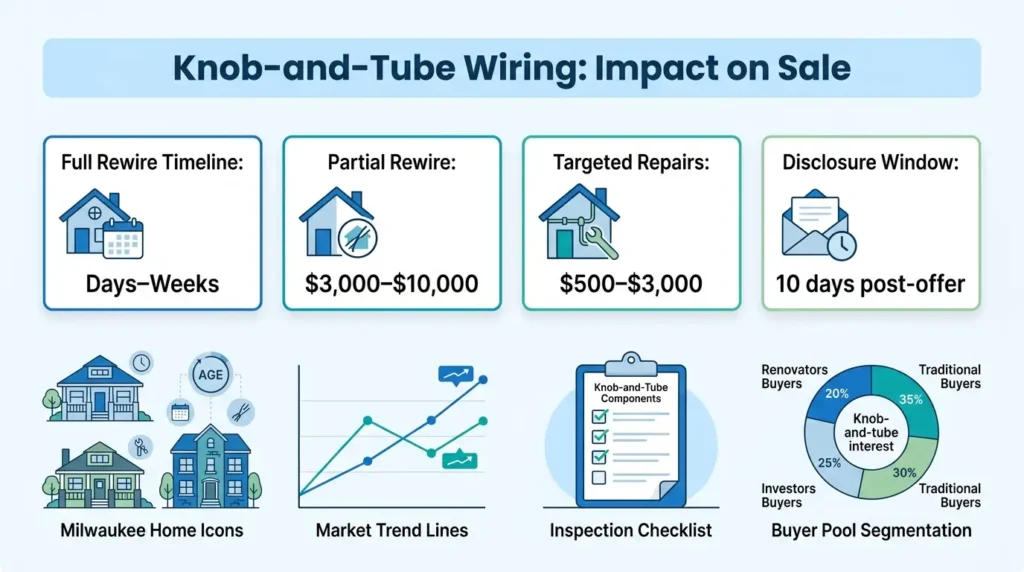
How Knob-and-Tube Wiring Affects Your Sale: Rewire vs. Sell As-Is
The biggest decision homeowners face is whether to invest in rewiring before listing or sell the property with the existing knob-and-tube wiring. There’s no universal right answer—it depends on your budget, timeline, and selling goals.
Rewiring can make your home more attractive to a wider range of buyers, particularly those using conventional financing. However, it’s also a significant investment that can delay your sale by several weeks or even months. Selling as-is, on the other hand, eliminates the upfront expense and allows you to move forward sooner, though you’ll typically market to a smaller pool of cash buyers willing to take on the electrical upgrades themselves.
| Factor | Rewire Before Listing | Sell As-Is With Knob-and-Tube |
| Buyer pool | Broad — most financed buyers can proceed | Narrow — mainly cash buyers and investors |
| Lender / insurer hurdles | Minimal once new wiring passes inspection | Higher risk of escrow holdbacks or insurer pushback |
| Upfront seller cost | High — commonly $12,000–$36,000+ | Low — no repair outlay before listing |
| Timeline to close | Longer — rewiring, permits, inspections, then marketing | Shorter — especially with a cash buyer |
In some Milwaukee price brackets, buyers will purchase with existing knob-and-tube if disclosures are clear and pricing reflects the wiring. Rewiring is not legally required. The decision comes down to whether the value gain from a broader buyer pool outweighs the rewiring cost.
However, the additional value isn’t always enough to recover the full cost of the project. Rewiring an older home often uncovers additional repairs, extends the selling timeline, and requires coordinating contractors, permits, and inspections before the home even reaches the market.
In many Milwaukee neighborhoods, buyers are still willing to purchase homes with existing knob-and-tube wiring as long as the condition is fully disclosed and the asking price reflects the expected upgrade costs. While the buyer pool may be smaller, serious cash buyers and investors often prioritize a faster, simpler transaction over move-in-ready electrical systems.
Wisconsin Disclosure Rules for Knob-and-Tube Wiring
Wisconsin sellers of most one-to-four-family residential properties must complete the Residential Real Estate Condition Report (RECR) under Wis. Stat. ch. 709. The form specifically identifies knob-and-tube as an example of an electrical defect — if you know it’s present, disclosure is required.
Under Wis. Stat. § 709.03, the RECR must be delivered within 10 days of offer acceptance. If you amend the RECR after delivery, the buyer gets a new two-business-day rescission window — so getting it right the first time, ideally with an electrician’s evaluation in hand, protects you.
Sellers who disclose honestly and proactively are in a significantly stronger legal position than those who stay silent. Full upfront disclosure typically reduces negotiation friction and keeps deals from falling apart late in the process.
Sample disclosure language (adapt with your attorney or agent):
- “Home contains knob-and-tube wiring. A licensed electrician’s report and cost estimate are available upon request.”
- “Knob-and-tube wiring is present. Seller has completed the RECR and encourages buyers to conduct their own electrical inspection.”
Note: This is not legal advice. Work with a Wisconsin real estate attorney or your listing agent to ensure your RECR is complete and accurate.
What It Costs to Upgrade Knob-and-Tube Wiring
Cost varies significantly by scope. A full rewire — replacing all knob-and-tube, upgrading the panel, pulling permits — is thorough but an expensive path. Rewiring can mean electrician bids, permits, walls being opened, delays, and a large bill before the seller even lists. Partial rewiring addresses only high-risk areas but leaves remaining K&T in place and still requires disclosure. Limited repairs (fixing splices, damaged insulation) are the least expensive but do the least for buyer confidence.
The best way to get an accurate Milwaukee number is two or three bids from licensed local electricians. Published national averages (Homewyse lists $9,600–$11,500 for a basic rewire) fall at the lower end of the real-world range for older Milwaukee homes with finished walls.
| Upgrade Path | Typical Cost Range | Timeline | Buyer Impact |
| Full rewire + panel upgrade | $12,000 – $36,000+ | Several days to weeks | Opens most financed buyers |
| Partial rewire (high-risk circuits) | $3,000 – $10,000 | A few days | Helps but lender overlays may still apply |
| Targeted repairs only | $500 – $3,000 | 1–2 days | Minimal — remaining K&T still flagged |
This when you should get pragmatic, is it practical to invest in repairs when it will not be appreciated. Remember, the buyer always has the choice to decide their future course of action. They can go ahead and keep the present status quo or go ahead with repairs right away or even consider changes later on.
How Lenders and Insurers Treat Knob-and-Tube Wiring
Knob-and-tube wiring doesn’t automatically prevent a financed sale, but it often creates additional hurdles. Some lenders may require a licensed electrician’s evaluation before approving the loan, while an appraiser could flag outdated wiring as a condition that must be addressed. Insurance companies may refuse to issue a new policy, charge higher premiums, or require repairs before providing coverage.
In some cases, lenders hold money in escrow until electrical upgrades are completed, delaying closing and increasing uncertainty for both parties. Cash buyers avoid these financing and insurance requirements altogether, making as-is sales faster, simpler, and less likely to fall through over wiring concerns.
Why Cash Buyers Are Often the Best Option for Homes With Knob-and-Tube Wiring
If your priority is selling quickly without investing thousands in electrical upgrades, a cash buyer can simplify the process. Unlike financed purchases, cash sales don’t depend on mortgage underwriting, lender repair requirements, or insurance approvals before closing.
Cash buyers are also familiar with older Milwaukee homes and understand that knob-and-tube wiring is common in many pre-war properties. Instead of asking you to complete repairs first, they typically evaluate the home’s overall condition and factor the expected rewiring costs into their offer.
With a cash buyer, you can often:
- Sell the property in its current condition.
- Avoid lender and insurance-related delays.
- Skip costly rewiring before listing.
- Close on a timeline that works for you.
For homeowners who value certainty over maximizing every dollar, selling as-is to an experienced cash buyer can be the most straightforward path to closing.
How Knob and Tube Wiring Affects Your Sale Price and Time on Market
Knob and tube wiring typically surfaces in negotiations as lower initial offers, requests for electrical repairs before closing, or a closing credit so the buyer handles upgrades afterward. All three scenarios mean the seller nets less than they would with an updated electrical system. The table below shows how market conditions shape the likely impact:
| Market Condition | Likely Impact on Sale |
| Tight market, low inventory | Well-priced homes with disclosed wiring issues can still attract solid offers |
| Soft market, higher inventory | Homes with knob and tube may sit weeks longer than comparable updated listings |
| FHA or VA buyer | Extra inspection hurdles likely; buyer may walk rather than navigate lender conditions |
| Cash buyer | No lender conditions; fastest path to closing for as-is sales |
Strategy that consistently helps: price the home with the wiring condition factored in from day one. Sellers who list at full market value and negotiate down after an inspection finding tend to lose more ground than those who price transparently from the start.
Selling As-Is: Step-by-Step Process
If rewiring doesn’t fit your timeline or budget, here’s how to sell as-is cleanly:
- Get an electrician’s evaluation. Hire a licensed electrician for a full assessment and written cost estimate. InterNACHI recommends this as the baseline step for any home with knob-and-tube.
- Collect repair bids. Two or three estimates give buyers a concrete scope — even if you’re not doing the work.
- Complete the RECR accurately. Disclose the knob-and-tube, reference the electrician’s findings, and deliver within the 10-day statutory window.
- Price to reflect the wiring. Work with your agent to set expectations based on comparable as-is sales and the estimated repair cost.
- Choose your sales channel. MLS listing, direct cash offer, or both simultaneously. A cash buyer — like Cream City Home Buyers — skips lender overlays and can often close faster with fewer contingencies.
The MLS may yield a higher price but carries more deal-fall risk from lender and insurer requirements. A cash offer trades price for speed and certainty. Neither path is inherently better — it depends on your equity, timeline, and risk tolerance.
FAQs: How To Sell A House With Knob and Tube Wiring
Do I legally have to rewire before selling in Wisconsin?
No. Wisconsin law requires disclosure of known defects, not specific repairs. You can sell as-is provided you complete the RECR honestly and set pricing accordingly.
Will knob-and-tube wiring scare off traditional buyers?
Not necessarily, but it can reduce your buyer pool. Some buyers may be comfortable with the wiring, while others may walk away due to financing, insurance, or future repair concerns. Transparent disclosures and realistic pricing help keep negotiations on track.
Will FHA or VA buyers be able to purchase a Milwaukee home with knob-and-tube wiring?
Possibly, but these loan types often trigger additional lender requirements — electrician certifications, escrow holdbacks, or repairs — that can delay or derail a transaction more than conventional loans.
Can a cash buyer close even if lenders or insurers have concerns?
Yes. Because cash buyers don’t rely on mortgage financing, lender requirements and many insurance-related delays are removed from the transaction. This often results in a faster, more predictable closing for homes with older wiring.
Does Cream City Home Buyers purchase homes with knob-and-tube wiring?
Yes. We buy Milwaukee-area homes as-is, including those with knob-and-tube wiring, and cover closing costs with no agent commissions. Honest disclosure and an electrician’s report are still expected.
Your Next Steps
Selling a Milwaukee home with knob-and-tube wiring comes down to three things: understanding what you have, disclosing it properly, and choosing the path that fits your situation.
A licensed electrician’s evaluation, a complete RECR, and realistic pricing put you in the strongest position — whether you list on the MLS, sell to a cash buyer, or pursue both. If you’re also dealing with other older-home issues alongside the wiring, our guide on selling a house that needs work covers how to think through repair decisions holistically before you list.
If you’d rather skip a five-figure rewiring project, Cream City Home Buyers can give you a no-obligation cash offer. No commissions, no hidden fees, and we cover closing costs.
Skip the Rewiring. Sell As-Is.
Cream City Home Buyers makes fair cash offers on homes in any condition.
No commissions. No repairs. Closing in as little as 3–7 days.
creamcityhomebuyers.com
